Building a Circular Product Lifecycle


Building a Circular Product Lifecycle
A week-by-week playbook for operations and supply chain leaders racing the July 2026 deadline.
You’ve read the regulation. You know the destruction ban lands on July 19, 2026. The question sitting on your desk now isn’t whether to build circular operations — it’s how fast.
Most consultants will tell you this takes 6–12 months. Legacy DPP providers will scope a multi-quarter integration project. By the time they’ve mapped your supply chain data, July 19 has come and gone.
Here’s what we’ve seen: brands go live on TieBack in one to four weeks. Not a proof of concept. Live — with products minted, passports active, and circular modules operational.
You have roughly 90 days until the deadline. You need four weeks to go live. That leaves you two months of runway to scale, optimise, and turn compliance into competitive advantage while your competitors are still in discovery workshops.
This playbook shows you how. Four weeks. Real timings. No IT dependency. No consultants.
Week 1: Data Upload & Platform Go-Live
Owner: Operations lead
The biggest piece of work isn’t configuring software. It’s getting clarity on your inventory state.
Step 1: Export your product master as a CSV. The same SKU-level or variant-level file your merchandising or operations team already works with. Material composition, country of origin, care instructions, product imagery, category data.
Step 2: Drag it into TieBack. From there, TieBack’s AI agent Tia takes over. She reviews the incoming CSV, checks for structural errors, performs automatic data mapping against the Digital Product Passport schema, validates every field, and produces a detailed error report for human-in-the-loop review.
No manual column mapping. No developer tickets. No waiting for IT capacity. If your CSV is clean, your entire product catalogue is live in TieBack within hours.
Step 3: Mint your first token batch. Create a batch for your priority SKU, mint the tokens (each one a unique digital identity), and export them as QR code PDFs or printable labels.
By end of Week 1, you have: product catalogue live, digital identities minted, and QR codes ready for physical products. The platform is operational.
Week 2: Circular Module Configuration
Owner: Sustainability lead + CX lead
Now that the foundation is live, you activate the circular modules that will drive your ESPR compliance and consumer engagement.
Circular Routing Define where products go when they reach end-of-life. Repair, resale, or recycling. Map your physical partners to these digital endpoints.
Repair & Maintenance Upload care guides and repair instructions. If you have a repair network, link their locations so consumers can find the nearest certified facility directly from the passport.
Week 3: Activate Ownership, Warranty & Handover
Owner: CX lead + brand/commercial lead
These are the modules that turn a static Digital Product Passport into a living product relationship.
Ownership & Warranty
When consumers scan a product’s QR code (or NFC/RFID tag), they register as the owner. That ownership record — cryptographically verified, GDPR-compliant — becomes the anchor for warranty validation, repair requests, resale authentication, and end-of-life routing.
Configure warranty rules per product category. Set claim workflows: submission → review → approval/rejection → resolution.
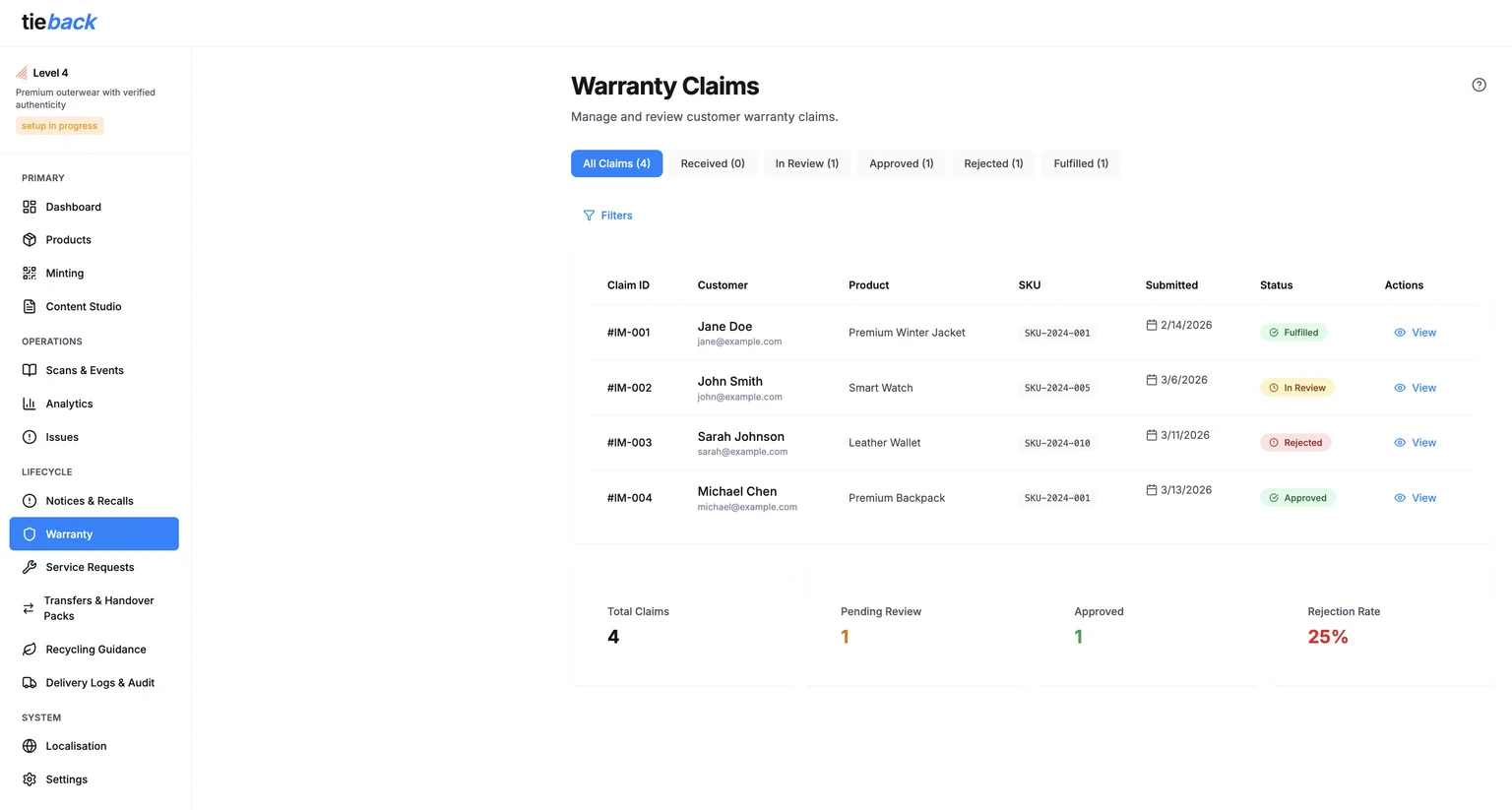 Warranty Claims: every claim tracked end-to-end — product, SKU, customer, status, and resolution patterns visible at a glance.
Notices & Recalls
Under the ESPR’s destruction exemptions, genuinely dangerous products are one of the few cases where destruction is still permitted. You need the ability to push targeted notices to affected SKUs and batches, track impressions, and document the response.
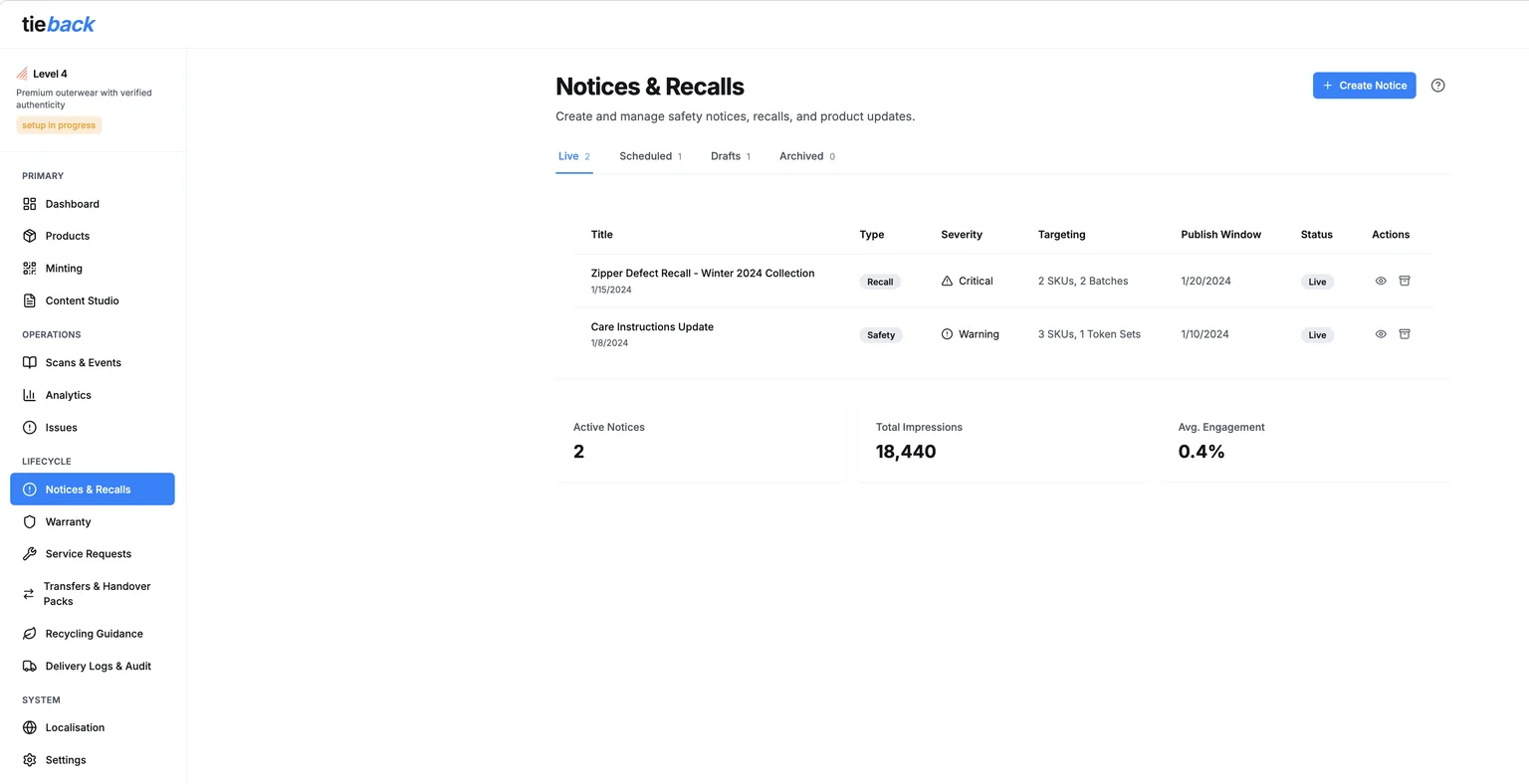 Notices & Recalls: target notices by SKU and batch, track impressions and engagement. Critical for documenting the safety-based destruction exemption.
Transfers & Handover
This is the module most brands underestimate — and where the real commercial upside sits. When products change hands on the secondary market, TieBack tracks the ownership transfer with full consent and GDPR compliance. The chain of custody stays intact. The brand retains visibility.
 Transfers & Handover: every ownership change tracked — consumer transfers, warranty swaps, replacements — with full from/to visibility.
Configure Handover Packs: the branded welcome experience that fires when a new owner claims the product. Care instructions, warranty status, brand story, and an invitation into the brand community. This is your first-touch customer acquisition moment with a secondary market buyer. No other Digital Product Passport platform does this.
Week 4: Test, Go Live & Monitor
Owner: All module owners → operations lead
Internal Testing
Before going live with real consumers, run the full workflow internally. Create test products. Claim ownership. Submit a warranty claim. Transfer ownership to a colleague. Trigger a Handover Pack. Route a product to recycling. Check every data handoff: does the Market Pack serve the correct language? Does the warranty claim route to the right team? Does the audit trail capture the fields required for ESPR annual disclosure?
Go Live
Push QR codes to your pilot product line — 500–1,000 units. Real consumers start scanning, claiming ownership, and entering circular flows.
Monitor & Iterate
The Analytics dashboard gives you real-time visibility: total scans, unique items scanned, verification outcomes (authentic, suspicious, invalid, locked), and geographic distribution.
Analytics: scan trends, verification outcomes, suspicious rate monitoring, and geographic insights — all filterable by date range, country, risk level, and context.
For product-level issues — consumers reporting incorrect details, unrecognised codes, suspicious activity — the Issues Inbox captures and triages them automatically.
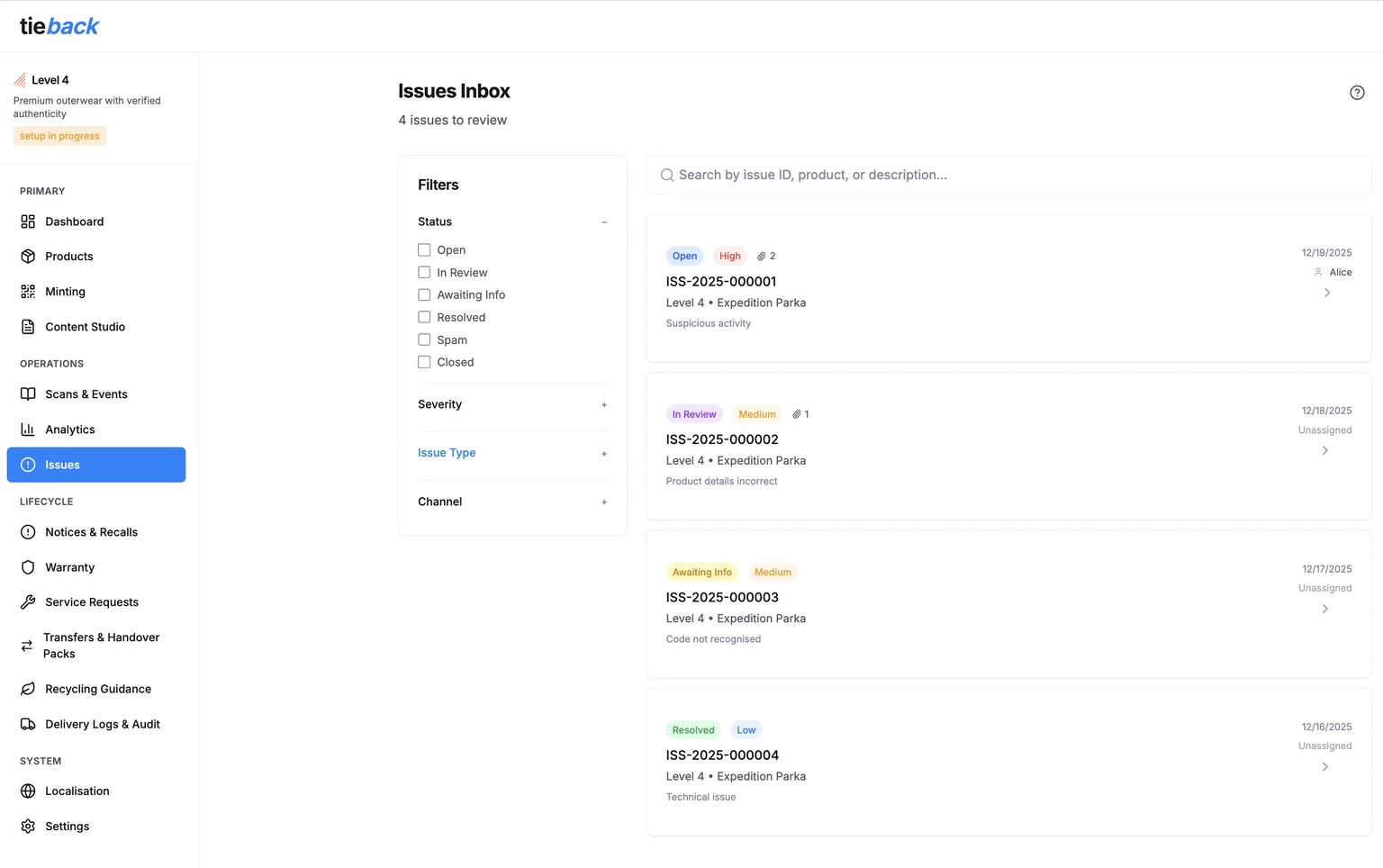 Issues Inbox: consumer-reported issues filtered by status, severity, type, and channel. Each issue linked to a specific product for fast resolution.
The Minting Activity & Audit log gives you the timestamped trail that underpins your ESPR disclosure data — every batch created, every token minted, every export generated, every activation recorded.
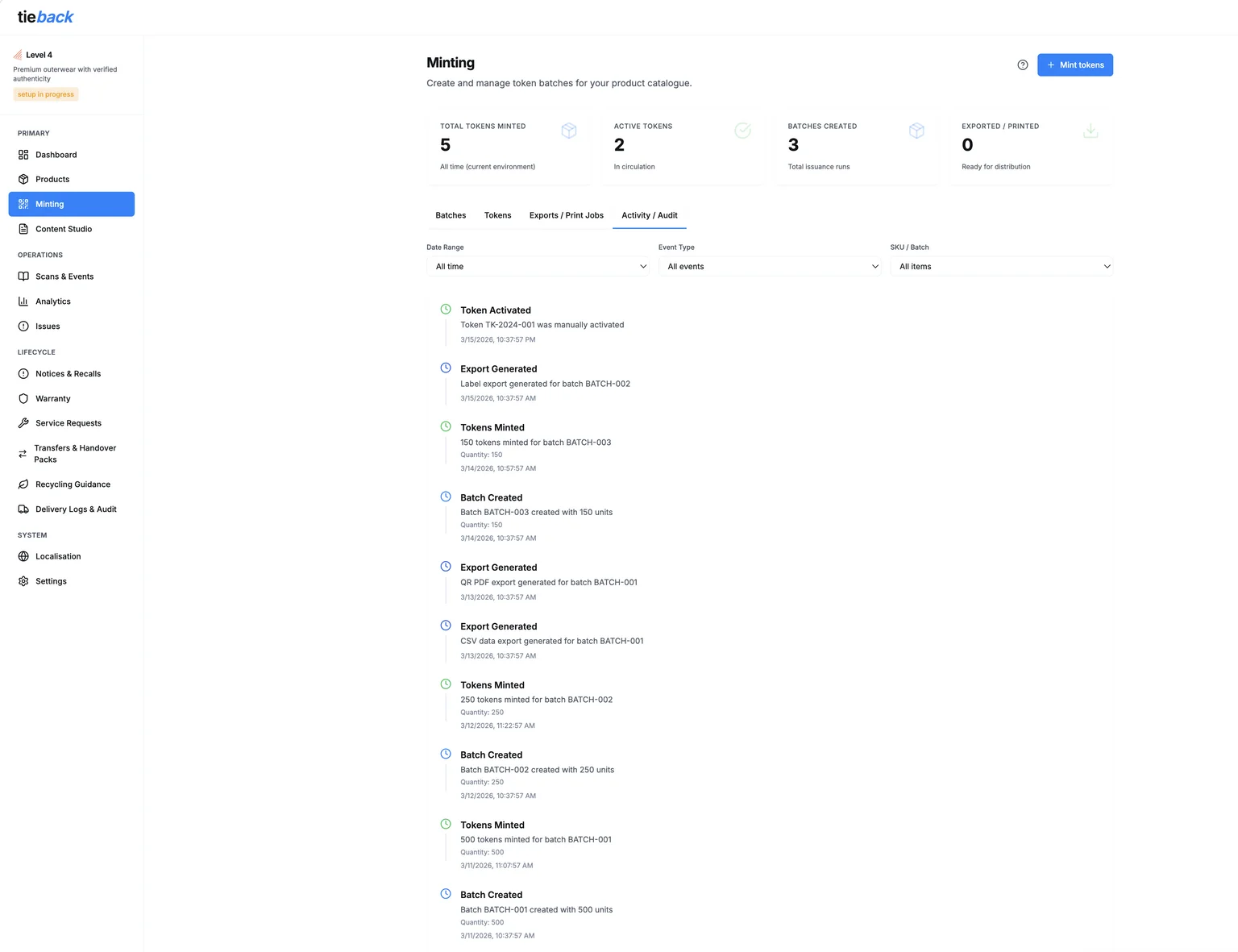 Activity & Audit: a complete, timestamped log of every minting, export, and activation event. Your audit trail for ESPR disclosure.
The Week-by-Week at a Glance
Data & Go-Live
Product catalogue live and first token batches minted.
Operations Lead
Market Config
Digital Market Packs & recycling instructions for EU regions.
Sustainability
Circular Flows
Ownership, warranty, and handover modules active.
CX / Brand Lead
Full Launch
Internal testing complete and real consumer scans monitoring active.
Operations Lead
What You Do With the Remaining 60 Days
You’re live. The platform is operational. Your pilot product line has a working circular lifecycle: ownership → warranty → resale/transfer → recycling. The audit trail is generating compliant data.
Now you have two months before July 19 to do what your competitors can’t: scale with confidence.
- Expand product lines. Roll the same configuration to additional SKUs and categories. Each one is faster than the first — the modules, Market Packs, and workflows are already configured.
- Activate remaining EU markets. Extend Market Packs from your initial 3–5 countries to the full 27. Localisation settings follow the same pattern.
- Layer in additional circular models. Rental, repair, donation routing — each model builds on the same ownership and Digital Product Passport infrastructure.
- Run your ESPR disclosure dry run. Extract the data you’ll need for annual reporting: products destroyed (trending toward zero), circular alternatives used, donation documentation, exemptions invoked. Validate the output against the EU’s standardised reporting format. This is the data your competitors, customers, and journalists will read. Make sure it tells the story you want.
- Scope API integration. With the CSV-powered platform already live, your IT team can now scope ERP and PIM integration on their own timeline — without the pressure of a regulatory deadline.
What This Sets You Up For
The destruction ban is the first enforcement test under the ESPR. It won’t be the last.
The EU Digital Product Passport Registry launches on the same date — July 19, 2026. The textile delegated act defining mandatory DPP data fields is expected in Q2 2027. Full mandatory Digital Product Passports for fashion and footwear arrive in late 2028 or 2029.
Every module you activate now — ownership, warranty, recycling, handover — is a module you won’t be scrambling to implement when the full DPP mandate lands. The fashion brands that go live now will be 18 months ahead of the pack — without a single consultant invoice.
Four weeks to go live. Ninety days until the deadline. The path is clear.